Stefan Molyneux is an alt-right podcaster whose YouTube account, as of this writing, boasts over 870,000 subscribers. I have previously written of how he copies and specifically cites, by name, Kevin MacDonald — co-host to David Duke’s white supremacist podcast — in propagating conspiracy theories about Jews in general, specifically that a Jewish cabal has a long history of trying to undermine the United States and the rest of the West, first by founding the communist movement, and later by debating in favor of liberalizing immigration into the West from Africa and Central America. (The latter phenomenon of which David Duke, Kevin MacDonald, and Stefan Molyneux have all publicly condemned as necessarily bad.) But Molyneux’s propagandizing for racism was and is even worse than I understood.
Stefan Molyneux: Even More Antisemitic Than You Knew
The journalist Cathy Young directed me to her September 6, 2018 twitter conversation with Brandon Bahret. In that exchange, Bahret called attention to another aspect of Molyneux’s anti-Semitism in Molyneux’s video “Migratory Patterns of Predatory Immigrants,” FreeDomain Radio podcast 3220 (given the alternate title, on the FDR website, “Migratory Patterns of Predatory Scientists”). For that episode, the caller into the show was a scientist from India taking residence in Germany. Because the caller initially thought of himself as sympathetic to Molyneux’s nationalism, he criticized Germans in general for fearing a resurgence of nationalism in their country, lest the horrors of the Nazi regime be repeated.
The caller says, “In Germany, it’s like the people . . .they . . . kind of . . . In Germany [ . . . ] people are kind of, like, after historically they had some bad kind of politics [Naziism], they always try to be good, so that they just never want to show them, like, [we] be proud Germany, [and say,] ‘We Germans are the highest in . . .’ blah blah blah and everything in this kind of...”
Molyneux then interrupts with a defense of antisemitism in 1920s and ‘30s Germany — a move that is shocking even for Molyneux.
The [1920s and ‘30s] Germans were in danger of being taken over by what they perceived as Jewish-led communism. And Jewish-led communism had wiped out tens of millions of white Christians in Russia, and they [Germans] were afraid of the same thing, and there was this wild overreaction [the Holocaust], and all this kind of stuff. So I just ran over that briefly with that stuff. [*No pause between that, andthisnext thought:*] But with regards to immigration as a whole, I mean there’s this interesting question to ask if you’re in someone else’s country — and I’d like to get your answer to this. There’s an interesting question to ask if you’re in someone else’s country, which is to say, “How would I sell me being in this country, to the natives?” [Boldface added.—S.H.]
For the remaining duration of the video, Molyneux berates the caller for being an immigrant and receiving taxpayer funding from a Western government.
Hear Molyneux Himself Say All This in This Video Montage
This video is 4 minutes, 17 seconds long.
From Stefan Molyneux’s Own Mouth: Molyneux Agreeing With the Nazis That They Were Only Defending Themselves From “Jewish-Led Communists” Who Started the Fight
Someone might want to be charitable and insist that Stefan Molyneux is merely talking about the Nazis’ delusion that Jews in general were communists, and that he does not agree with the Nazi delusion that Jews and communism deserve to be associated strongly with one another. But that’s not the case. In two other videos — uploaded months away from this one — Molyneux expresses agreement with the accusation.
In “The Truth About Immigration: What They Won’t Tell You,” at the 23 minute, 38 second mark, Molyneux proclaims,
Communism doesn’t particularly come from the Greek, Roman, Western, Enlightenment tradition; it generally comes from Jewish tradition. Certainly, of course, the founders of communism were Jews. Jews were less than two percent of the Russian population but were more than fifty percent of the leaders of the Communist Party, and, of course, a lot of them were in charge of concentration camps and so on, later on under the Soviet regime.
Molyneux’s claim that “more than fifty percent” of the leaders of the Communist Party in Russia were Jewish isn’t even accurate. A free-marketer named Jacob Levy pointed out to me that, out of the 19 members of the Central Committee elected by the Ninth Congress of the Russian Communist Party from April 1920 to March 1921, only four were Jewish. That is less than a quarter of them. There is a whole Wikipedia entry on how this same insinuation that Molyneux propagates, which has been around for a century, amounts to an old “antisemitic canard.” University of Warsaw philosophy professor Stanislaw Krajewski points out,
Most Jews were never communist or pro-communist and most communists were never Jewish. Various minorities were over-represented among the communists. This was, by the way, a paradox because communists believed they represented the working masses, the national majority.
Most Jews did not support communism. Even in post-war Poland when the choice for Jews was limited (this is also true of Hungary) the majority of Jews were not pro-communist and they mostly left Poland.
Whose Side Is Molyneux on, Regarding World War II? Not the Holocaust’s Victims, Apparently
Molyneux also spread the same antisemitic innuendo in an oral back-and-forth in the video “Criticism: Are Libertarians Wrong About Immigration?” This time, the call comes from a self-described libertarian who, at the time of the video’s recording, sounded as if he was still overall a fan of Molyneux’s but who took exception with Molyneux’s preaching that there must be more armed federal agents obstructing, at gunpoint, immigration into the USA and the rest of the West from the poor countries. In defending immigration, the caller brings up the incident of Jewish refugees aboard the MS St. Louis being denied safe harbor in the USA during the Holocaust. To the caller, that was a case study in the perils of denying entry to refugees in general.
* Molyneux: “If you shut down immigration, it would be a breather, and it would be far less taxes, and it might give white people more of an incentive to breed, rather than not have kids because they’re paying for everyone else’s.”
* Caller: “I mean, like, during the Holocaust, you know for instance, the Jews who were fleeing Nazi Germany were on the boat to Ellis Island, and FDR [President Franklin D. Roosevelt] sent them back, where they were killed. I mean I think that was pretty horrific, you know. The consequence of not having that immigration was that these people died and got killed. Right? So—
* Molyneux: [*Shrugs; unmoved*.] “[*Blandly*.] Yeah, so it’s really bad what Hitler did.”
* Caller: “Right. But FDR could have helped by allowing the Jews to have a safe haven, right?” [ . . . ]
* Molyneux: [*This is now at the 58 minute, 40 second mark.*] “[Point] Number Two is that a lot of Jews in Europe in the 1930s were communist. Oh, by God, were there a lot of communists, and a lot of the communists were Jews. Maybe they [U.S. immigration authorities during World War II] couldn’t vet them [Jews on the MS St. Louis seeking refuge in the USA]. Maybe they [the Jews fleeing Hitler] didn’t have papers. Maybe they [U.S. immigration officials] were concerned that Hitler was fighting, right, it was Naziism versus Bolshevism, right? The communists and Nazis were fighting tooth and nail in the streets in Germany.
“And, of course, a lot of Jews, as I’ve talked about before, a lot of Jews were instrumental in the founding of communism, in the spread of communism. Jews were — what? — two percent of the Russian population but forty percent of the communists, and so on. And so, there were a lot of Jews who were instrumental in the founding of communism. [Italics are emphases from Molyneux; emphases by me are in boldface. —S.H.]
“This was a very strong anticommunist time in America, and communists were infiltrating the U.S. government considerably. I mean, this ‘McCarthyism’ hysteria, and so on? There was real foundation for it [widespread fear of immigrant communists infiltrating the USA]. There were hundreds of Soviet spies all riddled throughout the U.S. government, particularly in the State Department, particularly in the embassies out in China, which is one of the reasons why massive segments of the world population were lost to communism in China, ‘cause there were huge riddles of communists throughout the place.
“So I don’t know the history, but I think that would be a bit of a security concern [*sarcasm in Molyneux’s tone, implying that the words are an understatement of the dangers from Jewish immigrants*]. So [*shrugs*] you’d have to ask FDR if you could, but I don’t know [*smug smile*], maybe the factors exist [justifying denial of the Jews aboard the MS St. Louis into the USA] and maybe they don’t, but there were some [valid national] security concerns about [Jewish] intellectuals fleeing Germany, because a lot of them weren’t, like, freedom fighters who didn’t like Naziism. A lot of them were like, ‘Damn, we didn’t win with communism. We communists didn’t win, so let’s go flee to America.’ [*Sarcastic again*:] Well, I don’t know that you want a bunch of communists coming into America. You know, it didn’t do America a lot of good during the Cold War.” [Italics are emphases from Molyneux; emphases by me are in boldface.
—S.H.]
Conclusion
When Stefan Molyneux said that Nazis thought that Jews in general were communist, it is the case that he has publicly voiced agreement with that belief on other occasions in relatively close proximity, time-wise. He proclaims that Germans in the 1920s and ‘30s were correct to be afraid of Jews in general for this reason, and that the Nazis were merely retaliating, in self-defense, against the “Jewish-led” communists whom Molyneux presumes to be the party that incited the mutual hostilities between Nazis and Jews. As for the brutalization and extermination of six million Jews in concentration camps, all that Molyneux could say of it was that it was an “overreaction” on the Nazis’ part. With that out of the way, Molyneux quickly moved on to his routine derogation against nonwhites from the developing countries.
UPDATE from October 29, 2018
The day before I first uploaded this blog post, an assailant went on a shooting rampage at a Pittsburgh synagogue. It was horrible, but that is not what initially motivated me to write out this blog post; I planned the blog post independently of that. On October 28, 2018, the same day I uploaded this blog post, Stefan Molyneux uploaded onto YouTube a video he titled “The Truth About the Pittsburgh Massacre,” where, after everything he has said over the past decade, he feigns sympathy for Jews. He spends time in the video’s first half on a tirade where he laments that when Jews marry gentiles, that is a “dilution” of purity and a “silent Holocaust.” From the 25:00 to 28:00 mark, he says he was influenced by Ayn Rand, Milton Friedman, David Friedman, Murray Rothbard, and Walter Block — all Jewish — so he doesn’t spread bigoted attitudes about Jews. He hasn’t retracted his comments from 2016 where he said blocking immigration from Jews 79 years ago was a morally proper measure to counter “Jewish-led communism.” In this video, he talks as if he never said any of that.
At the end, he says something interesting: that he absolutely condemns the thought of anyone using violence against other people for disagreeing with his opinions on politics or religion. I find that interesting as, for the past couple of years, Molyneux has argued publicly that violent force should be used against particular ethnic groups for the reason that most people from those ethnic groups disagree with Molyneux about politics and religion. That Molyneux has indeed publicly advocated violent force against such people, and for such reasons, is something for which I provide evidence in this follow-up blog post.
Book Review: Money Changes Everything: How Finance Made Civilization Possible By William N. Goetzmann
Stuart K. Hayashi
Me with the book (this is a copy from the library).
Finance professor William N. Goetzmann -- son to the famous Pulitzer Prize-winning historian William H. Goetzmann -- has come out with a fascinating book titled Money Changes Everything: How Finance Made Civilization Possible (New Haven, CT: Yale University Press, 2016). It purports to be a comprehensive history of finance from the very time of its founding. Except for suffering from two large and regrettable shortcomings, it does a good job.
Best Definition of Finance I’ve Come Across
It begins by providing a definition for finance, better than any I heard in business school. According to Goetzmann, finance has three components. First is trade. Two parties agree to some exchange of values. The second component is time -- finance is all about the future. In the financial give-and-take, one party agrees to a specific action in the present whereas the other party agrees to a specific action in the future. When you receive a value in the present in exchange for promising to do something of value in the future, you are the debtor; the debt is settled once those commitments are met. The party that provided a value in the present and that is to receive another value in the future is the creditor. Also possible is that one party agrees to perform a specific action of value in the near future as the other party agrees to perform another specific action of value in the farther future. That finance is about promises to perform specific actions in the future is the reason for the third component: documentation. So that both parties can be held to the promises they made, the agreement must be written out for future reference, and the values exchanged are to be quantified so that there is precision in the measurement of values in case of future dispute among the parties.
Indeed, the words finance and finish come from the same root. It refers to paying off all of a debt at least, thereby finishing the debt. That is also how, in the European Middle Ages, the term of governmental fine arose -- the fine is what the government declares to be the debt you owe it.
Goetzmann’s explanation of the definition of finance also helped clarify a matter that had long nagged at me -- the distinction between economics and finance. People frequently get economics and finance mixed up. Both sciences involve money and the exchange of values and other resources in the service of satisfying marketplace demand. However, here are some differences.
First, in economics the emphasis is on the past and present. Economists look at what happened in the past and they tell you what is going on in the present. Economists are indeed frequently called upon to forecast future conditions, but forecasting is not essential to the profession -- that is, you can still practice economics even if you don’t make forecasts. Moreover, even when an economist does forecast future conditions, he or she is not necessarily planning for that future -- it is the parties planning for the future who pump the economist for predictions. By contrast, planning for the future is inherent to finance; if no promises for future actions are made, then it’s not finance.
Secondly, finance is a much more normative science than is economics. An economist can tell you that, under specific economic conditions, there will be specific results, but the economist doesn’t have to conclude that this is good or bad; the economist does not necessarily tell you what ought to be done. By contrast, finance is perforce normative: to be a practitioner in finance means that you either know which specific procedures a good financier ought to follow, or you are looking to discover what are the best specific procedures. Those procedures in finance are ultimately for the purpose of reallocating resources where they are in lower demand, transferring them to where they are in higher demand. Every financial instrument serves at least one of the following functions.
Directly reallocating resources, taking them where they are in lower demand, and placing them where there is greater marketplace demand for them.
Transmitting data to participants in the market about changes in supply or marketplace demand so that they can make better-informed decisions on how to maximize the satisfaction of marketplace demand.
Finally, finance -- usually more so than economics -- focuses on what a specific party ought to do. Economists look at multiple participants in a market -- the consumers and vendors -- and recognize that the conditions in the market are the accumulated sum of many individual choices. By contrast, when you think about finance, you are thinking specifically about how your own household or firm in particular ought to plan for the future and meet its commitments as you manage its resources.
If Finance Bores You, Perhaps This Re-Interpretation of It Might Help...
I know that many people find finance boring; with just one glance at numerical figures on a page, their eyes glaze over. Too many people dismiss finance as merely crunching numbers and pushing papers around. They find it tedious at best and incomprehensible at worst because they don’t recognize what the numerical figures represent. Finance is actually not fundamentally about money as such, but the values for which the money is traded.
A moneylender is not fundamentally using money to make more money, but is performing the service of providing you with values and resources in the present, at a time much sooner than they would otherwise be available to you; the interest you pay to the moneylender is the fee you pay to the lender for the service of availing these values to you more promptly than they otherwise would be availed. It is often said that time is money; when you pay interest on a loan, what you are purchasing is time. When you examine financial documents, it’s helpful to visualize what those figures represent: the resources being reallocated, made accessible, to entrepreneurs for the production of goods and services for your benefit. Visualize how those numerical figures make it possible for you to take the vacations you love. When you see it that way, finance becomes much less boring.
I am thankful to Goetzmann for helping clarify this for me. However, this is a book on history, so let’s get to that.
How the Written Word Began With Finance
Right from the first chapter, Goetzmann offers important observations that too many historians, economists, and financiers have overlooked for too long: finance was integral to the invention of written language itself, as the ancient Mesopotamians first invented writing for the purpose of documenting contractual agreements whereby at least one of the parties had to fulfill an obligation -- a debt -- at a future date. The first written characters were standardized pictograms -- a particular symbol would represent a single unit of grains. As the transactions grew more sophisticated, though, the pictograms ceased to be adequate; they were replaced by a much larger number of wedge-shaped symbols that came to be known as cuneiform. The fact that writing was first invented for the purposes of bookkeeping, accounting, contracting, and finance has been well-known among archaeologists for decades, but not even they have fully understood the ramifications this fact has had for our modern life, and hence they had not phrased this point as clearly as Goetzmann has. Today we read so many essays that amount to screeds about the evilness of commerce and finance. Yet it is to commerce and finance that we owe the very existence of writing, the original information technology. These ancient Mesopotamians likewise invented arithmetic for the purpose of adding precision to their production and trade of goods and of their settlements of debts.
Goetzmann even goes as far as arguing that because finance and contracts developed the abstraction skills of the ancient Greeks, it is the case that, however much the ancient Greek philosophers disdained financiers, it was the abstraction-building of the ancient Greek financiers that made ancient Greek philosophy possible.
Atlas Shrugged in Ancient Babylonia; Ancient Athens Was Where the First Antitrust Trial Took Place
I have read histories of ancient Greece and ancient Rome before, but this was the first book I remember reading that adequately explained how finance and usury were integral to their development. The book even elaborates on how the archaeologist Marc Van de Mieroop discovered that, as a consequence of King Rim-Sin imposing price controls -- specifically, caps on interest rates -- on the Mesopotamian city-state of Ur, the city-state's economy stagnated and never truly recovered. Atlas shrugged even in ancient Babylon! Moreover, Goetzmann goes over the testimonies of a trial of grain merchants in ancient Athens who were threatened with the death penalty upon being accused of forming a cartel to drive up grain prices -- history's earliest recorded antitrust trial. In these respects, I learned much.
This Book Acknowledges That Ayn Rand’s Contribution Is an Important Part of the History of Global Finance(!!!)
Goetzmann even has a section near the end titled "Seeds of Objectivism." In his history of finance -- that goes all the way back to ancient Mesopotamia and the invention of writing -- Goetzmann properly recognizes Ayn Rand's writings as essential to this history. Predictably, Goetzmann doesn't agree with Ayn Rand; he admits that she is too idealistic for a cynic such as himself. Political conservatives, so pessimistic about human nature, routinely find Ayn Rand too idealistic for their taste. And, also typical for a political conservative, Goetzmann tritely says Ayn Rand is in the same category as Karl Marx on account of being "utopian."
Despite Goetzmann's silliness there, I have to give him credit for being honest enough to admit that rejecting Ayn Rand's philosophy is an act of cynicism. On some level, the left-wing writers who trash Ayn Rand are aware of this, but they prefer to put on the pretense that Rand’s defense of peaceable self-interest actually makes her too cynical for them -- they want to posture as the truuuuuuuuue idealists. At least here, with Goetzmann, we find an author fessing up to the actual reason so many authors are uncomfortable with Ayn Rand's ethical theories.
Book Becomes Less Interesting the Closer It Gets to Modern Times, Thanks to the Lip Service to Keynesianism
When it comes to giving a full history of finance, the book has two major weaknesses. First, the author blindly accepts the Keynesian (mis)interpretation of the events of the twentieth century. Goetzmann properly points out how medieval Chinese central banks failed to sustain the command economy simply by printing money and devaluing each monetary unit, and yet this same Goetzmann presumes that a sprawling central government can sustain itself forever by borrowing money to fund its myriad programs. Anyone who presumes that the U.S. federal government’s present method of financing itself through debt can be sustained in the long term has no business accusing Ayn Rand or anyone else of being impractical.
You Can’t Have a Complete History of Finance If You Avoid Addressing Antisemitism
The other major weakness is much larger: Goetzmann glosses over the topic of antisemitsm altogether. For what is supposed to be a grand overview of the history of finance throughout the world, since pre-Biblical times, this is conspicuous. You actually cannot have a well-integrated history of finance if you overlook the involvement of antisemitism.
Many people are familiar with the stereotype that Jews are savvy about finance in general and moneylending in particular, but very few people ask themselves how this stereotype came to be -- there wasn’t even anything voluntary on the part of Jews when it came to this association. This came about during the high Middle Ages. After centuries of economic stagnation throughout the early Middle Ages, nobles and royals came to admit to themselves that, if they wanted to build up their palaces and armies, they had to allow some liberalization when it came to finance. They had an enormous dilemma: the church still proclaimed it a terrible sin for Christians to loan money to other Christians at a profit; that was usury. One of the first loopholes to this rule that nobles exploited was their decision to have it legal for Jews to loan money to Christians at a profit. They considered this sinful as well, but they figured that Jews were going to go to hell anyway for not being Christian, so what additional harm could there be?
At the same time, Jews wanted to enter many other professions, but this was forbidden to them by law. Jobs were controlled by craft guilds -- government-enforced cartels. If you were in medieval Europe and wanted to become a blacksmith, you had to join the blacksmith guild . . . and Jews were barred from them. For this reason, from the high Middle Ages to the Renaissance, Jews loaned money at a profit to Christians because that was the only work available to them -- and, for centuries thereafter, people throughout the Western world ignorantly presumed that Jews were moneylenders solely because they had some innate preference for that profession over all others!
Incidentally, a similar phenomenon happened with Jews in motion picture productions and in publishing. Anti-Semites carp about Jews being prominent in Hollywood and even in business of publishing comic books, but those anti-Semites don’t bother to ask themselves why Jews ever became prominent in these industries. It was that in the early 1900s in the USA, Eastern European Jews still faced a lot of discrimination when it came to looking for work. Hence, to earn any money at all, they had to resort to starting their own businesses. In the early 1900s, the industries of comic book publishing and motion picture production were just emerging. Jews that faced heavy discrimination noticed these nascent enterprises and thus jumped at those opportunities, starting motion picture production studios and comic book publishing houses that eventually became the leaders in the respective industries.
The association of Jews with finance was even a major contributing factor to the ascension of the Nazi movement and the outbreak of the second World War. Adolf Hitler first joined the Nazi Party, back when it was still called the German Workers Party, on account of this association. In September 1919, Hitler's employer, Karl Mayr, tasked him with attending a lecture by German Workers Party member Gottfried Feder; Hitler was to report back to Mayr about this. The topic of Feder's speech was the evilness of Jews for lending money to Aryans and then charging them interest for those loans. Intrigued, Hitler chatted with party founder Anton Drexler, who handed him a pamphlet, titled My Political Awakening, arguing these same points about how there needed to be political action to curb the activities of Jewish bankers. Hitler joined the German Workers Party, got its name changed to the National Socialist German Workers Party and, with Drexler, co-authored a new platform for the party that made it a special point to demand that the State restrict what Jewish financiers could do. The widespread hatred for Jewish financiers was a great part of the Nazi Party’s appeal throughout the late 1920s and early 1930s.
The antisemites’ association of Jews with finance was so instrumental among the factors contributing to the causes of World War II that no history of the war would be complete without it. Likewise, for a purported complete history of world finance -- going all the way from pre-Biblical ages to the present -- to ignore this topic, makes for the most glaring omission.
And yet, when Goetzmann goes over finance during the Middle Ages, he only talks about the Knights Templar loaning money. The Knights Templar were indeed interesting -- especially with respect to how King Philip cited Biblical doctrine against homosexuality as he leveled trumped-up accusations against the Knights Templar in his effort to seize their wealth -- but replacing the history of Jewish financiers with the history of the Knights Templar is hardly excusable in what is supposed to be an exhaustive history of finance.
Conclusion
Aside from those two major errors, the history of finance in ancient Mesopotamia, Greece, and Rome is engrossing. As is typical of books that claim to give a comprehensive economic histories of the world, the book is most objective in discussing early history but increasingly adheres to the conventional statist interpretation as the text gets closer to the twentieth century.
Those Who Presume That Marx and Engels Were Too Naïve to Anticipate Communism’s Atrocities Should Bother to Read Them in Their Own Words Stuart K. Hayashi
Statues of Karl Marx and Friedrich Engels (left to right, respectively) in Berlin;
source: Wikimedia Commons.
On July 22, 2017, Yaron Brook of the Ayn Rand Institute tweeted out an op-ed by British politician Daniel Hannan. This concerned a public monument in Manchester, England, dedicated to Friedrich Engels, the primary financial patron to Karl Marx and the co-author of The Communist Manifesto with him. The monument is to celebrate Engels's having lived in Manchester on account of his having managed a factory there that his father owned. Hannan argues that, given that over one hundred million people were murdered in the name of the ideology that Engels promoted, the erection of a monument to him is comparable to setting up a statue to commend Adolf Hitler. Dr. Brook agrees with Hannan.
Predictably, Dr. Brook received flack over this. One man tweeted to Dr. Brook exactly the sort of retort one would expect: Hannan and Dr. Brook are "off base" in "comparing Engels to Hitler..." According to the reply, Engels was merely an "author and (awful) economist," whereas Hitler was a "politician and mass murderer." Indeed, many people frequently try to let Marx and Engels off the hook by saying that the murders committed in the name of communism were committed only by such government officials as Josef Stalin, Mao Tse-Tung, Pol Pot, Fidel Castro, Ho Chi Minh, Nicolae Ceaușescu, and Kim Il-Sung. By contrast, it is said, Marx and Engels were merely theorists who never got their hands dirty.
It is quite convenient that the same people who insist that Marx and Engels cannot be properly blamed for communist dictators' actions usually frequent the same intellectual circles that try to blame Herbert Spencer and William Graham Sumner for inspiring eugenics and therefore ultimately inspiring the Nazi movement. As I have written, eugenics and Naziism come from a philosophic tradition that is independent of, and even hostiletoward, Spencer's and Sumner's free-market evolutionism. Had Spencer and Sumner never been born, eugenics and Nazism still would have emerged as philosophic traditions. They sprung from the statist collectivist preachings of such figures as Joseph-Arthur de Gobineau, Georges de LaPouge, and Houston Chamberlain. The laissez-faire liberal republicanism that Spencer and Sumner advocated was the exact opposite of that mindset.
With respect to the contention that a pro-statism, anti-reason philosopher's hands are clean if he never committed any violence himself, Dr. Brook addressed that point in his Living Objectivism podcast on July 24, 2017. As Leonard Peikoff did decades earlier in his book The Ominous Parallels, Dr. Brook argued that even if a philosopher did not enact any violence personally, he should still be considered morally culpable if he laid the philosophic foundations for all of the rationalizations that were given for totalitarianism throughout the twentieth century. Although Drs. Brook and Peikoff did not bring up Houston Chamberlain specifically, it is proper to judge Chamberlain as culpable for the atrocities performed in the name of eugenics. Chamberlain devised myriad rationalizations for racism and anti-Semitism, giving a veneer of respectability to such violence. Similar logic should be applied to Marx and Engels.
I want to broach a matter that is different but related. I agree with Dr. Brook that even if Marx and Engels never anticipated the atrocities that their writings would inspire, justice would require judging them as accessories contributing to such evil. However, the history behind communism is much worse than that. The hundreds or thousands of people -- usually university students -- who confidently proclaim that Marx and Engels were too naïve to have predicted the violent consequences of their advocacy are people who demonstrate their own ignorance when they issue such a proclamation. Such people are just making assumptions. The more you read Marx's and Engels's writings, the more you find that they were not naïve on this matter at all. To the contrary, Marx and Engels both wrote explicitly that they expected that large numbers of people would be slaughtered in the process of bringing about a communist revolution. Moreover, Marx and Engels condoned it completely.
Marx pronounced that every form of government other than communism -- including that of a constitutional liberal republican Night Watchman State -- is inherently some violent imposition initiating the use of force upon the masses. Therefore, as far as Marx was concerned, any communist overthrow that involves communists killing people is simply morally justified self-defense on the communists' part. Hence, in writing about wars in Europe, Marx remarked on November 6, 1848, "...there is only one way in which the murderous death agonies of the old society and the bloody birth throes of the new society can be shortened, simplified and concentrated, and that way is revolutionary terror." By revolutionary terror , Marx meant killing hundreds or thousands of people. (I learned from Stephen Hicks of Marx saying this.)
Marx continued to urge such brutality in the three decades that followed. In January of 1879, the Chicago Tribune asked Marx whether "to carry out the principles of socialism do its believers advocate assassination and bloodshed?" To that, Marx replied unashamedly, "“No great movement, has ever been inaugurated Without Bloodshed" (Marx evidently could not conceive of a rebellion such as Mohandas Gandhi's).
Likewise, the comparison of Engels to Hitler is apt for more reasons than probably even Daniel Hannan realizes/ Engels stated his hope that when militaries finally ushered in a new epoch of communism, they would exterminate whole races of people. Specifically, Engels hoped all the Slavs would be massacred. Hence, in 1849 he cheered that
the Austrian Germans and Magyars will be set free and wreak a bloody revenge on the Slav barbarians. The general war which will then break out will smash this Slav Sonderbund and wipe out all these petty hidebound nations, down to their very names.
The next world war will result in the disappearance from the face of the earth not only of reactionary classes and dynasties, but also of entire reactionary peoples. And that, too, is a step forward.
Note that Engels is not merely asking for the deposing or surrender of a particular State; he is hoping that everyone of a particular race, whom that State represents, shall be on the receiving end of "bloody revenge." And, tellingly, he wants "Germans" to be the ones wreaking that "bloody revenge" on "reactionary peoples" -- all members of an ethnic group -- whom he deems "barbarians."
This reminds me of some people who like to say, "The Soviet Union only went wrong because that selfish scoundrel Josef Stalin succeeded Vladimir Lenin as the head of state. If only Leon Trotsky took over from Lenin instead, everything would have gone better." That talking point presumes that somehow Trotsky was benign. In reality, Trotsky was Lenin's right hand in committing mass executions in the Ukraine. Trotsky ordered that any communist caught deserting the Red Army be slain. He also demanded capital punishment for any Soviet citizen who was truant from work. Trotsky's bloodthirstiness is chronicled in the books A People's Tragedy by Orlando Figes and Trotsky: The Eternal Revolutionary by Dmitri Volkogonov.
After having lost his power struggle against Stalin, Trotsky pointed out that Stalin's denial of jobs to him and other purge victims was an attempt on Stalin's part to use the apparatus of the State to starve them to death: "In a country where the sole employer is the State, opposition means death by slow starvation. The old principle: who does not work shall not eat, has been replaced by a new one: who does not obey shall not eat." That is true, but Trotsky conveniently tries to elude responsibility for the fact that he was an accessory with Lenin and Stalin in imposing those circumstances on everyone in Russia in the first place. To find the man who gave Stalin such a loathsome weapon, all Trotsky needed to do was glance in a mirror.
Likewise, Ernesto "Che" Guevara stated openly that he hoped the Cuban missile crisis would lead to millions of Americans burning to death:
What we say is that we have to walk the path of liberation, even if it costs millions of atomic victims, because in the struggle to the death between two systems, nothing can be thought of except in the final victory of socialism, or its Retreat under the nuclear victory of imperialist aggression.
The point of Drs. Brook and Peikoff stands. Even if Marx and Engels did not foresee how their advocacy would lead to mass murder, they would have to be judged on account of mass murder being the philosophic preachings of Marx and Engels taken to their logical conclusion. Still, I think we should clarify that Marx and Engels did indeed foresee the day on which some ideological followers of theirs would slaughter millions of other human beings in order to make Marx's dream a reality. And Marx and Engels openly relished the idea of that happening. Their blood lust was comparable to that of Stalin's. The difference is that unlike Marx and Engels, it was Stalin who arrived in history late enough to implement the programs of mass murder and mass executions for which Marx and Engels had yearned.
On Friday, October 8, 2021, I shortened many of the sentences by splitting them into shorter sentences.
"It's Just Edgy Humor or Satire"? A common excuse frequently delivered in favor of alt-right trolls -- the ones who send unsolicited pictures of Nazis, or of Jews in gas ovens, to such "establishment cuckservatives" as Jonah Goldberg and Ben Shapiro -- is that they are merely expressing a dark sense of humor; they are not racist and should not be taken literally.
Just as the kids of the [']60s shocked their parents with promiscuity, long hair and rock’n’roll, so too do the alt-right’s young meme brigades shock older generations with outrageous caricatures, from the Jewish “Shlomo Shekelburg” to “Remove Kebab,” an internet in-joke about the Bosnian genocide. . . .
Are they actually bigots? No more than death metal devotees in the [']80s were actually Satanists. For them, it’s simply a means to fluster their grandparents. . . .
...the alt-right openly crack jokes about the Holocaust, loudly -- albeit almost entirely satirically -- expresses its horror at “race-mixing,” and denounces the “degeneracy” of homosexuals . . . while inviting Jewish gays and mixed-race Breitbart reporters [this is referring to this essay's co-author Allum Bokhari] to their secret dinner parties. What gives?
If you’re this far down the article, you’ll know some of the answers already. For the [alt-right's practical-joking] meme brigade, it’s just about having fun. They have no real problem with race-mixing, homosexuality, or even diverse societies: it’s just fun to watch the mayhem and outrage that erupts when those secular shibboleths are openly mocked. . .
The intellectuals [of the alt-right -- here, Yiannopoulos means Richard Spencer --] are animated by a similar thrill: after being taken for granted for centuries, they’re the ones who get to pick apart some of the Enlightenment’s dead dogmas.
It turns out that Milo is speaking from experience. In 2006, when he was in his early twenties and calling himself "Milo Andreas Wagner," he adopted a Nazi sympathizer persona -- allegedly in jest, naturally. As one example, he strolled around in public adorning a Nazi Iron Cross necklace.
In 2009, Yiannopoulos uploaded this image -- again, "jokingly."
In his apologia for alt-right trolls, Yiannopoulos asserts that these trolls merely wear "the mask of racism." That is quite the postmodernist ploy -- the real concealment, the true disguise, is in the insistence that the racism is but a mask.
For much of late 2014 and early 2015, before I learned about Milo's Nazi fetish, and when I still wanted to believe Yiannopoulos was my ally against politically-correct fanaticism and the "Social Justice Warriors," I saw increasingly offensive tweets done in the name of humor, and I wanted to believe that it was safe to dismiss them as callous humor not to be taken literally. "It's just the satire that is common on 4chan," I was told. Here is the reason why, when many hostile, Nazi-themed tweets are sent to Jonah Goldberg and Ben Shapiro, very few of those should be dismissed as just humor or satire, even when most of them try to pass themselves off as being humorous in tone.
The Good-Looking Female, Her Racist "Jokes," and the "Thirsty" Men Who Reinforce Her
Some years ago I interacted with this one female on (anti)social media; she was in her twenties, and very good-looking. No matter what she said on (anti)social media -- no matter how vile -- she would get a hundred "likes," mostly from (very "thirsty") men. Among the online status updates that received hundreds of "likes," were her "jokes": making light of the death of Whitney Houston (this mostly related to drugs, not race), saying that her boss is always trying to cheat her because he's Jewish and that's just what Jews do, and that all Asian-descended people in the USA look and behave exactly alike. The first few months this went on, I told myself, "As unfunny as she is, she's still just joking..."
This trend went on for more than a year. Her consistency in derogating Jews and Asians was remarkable. By the end of the year, I had to admit to myself,
I don't think she is joking. I think she seriously harbors these deep-seated prejudices, but knows that if she stated outright that these were her actual opinions, she would receive well-earned flack over it. Hence, she expresses these prejudices under the guise of being "tongue in cheek." If someone calls her out for expressing racist sentiments, she can issue the stock reply, "Didn't you notice the facetious tone? Can't you take a joke?"
There is an old term for this type of behavior. It is called being passive-aggressive. Someone is passive-aggressive when she wishes to express some type of anger or hostility toward someone, but, out of fear of some blowback, she does not want the expression to be recognized exactly for what it is. Therefore, she lashes out at her target in a somewhat sneakier fashion.
A more precise expression for this particular phenomenon is kidding on the square. As World Wide Wordsexplains it,
Somebody kidding on the square makes a joke but means it, too. . . . The idiom is known from the early twentieth century -- it turns up in February 1907 in McClure’s Magazine and is often recorded in the years that follow. . . .
If you are on the square, you’re honest or sincere, an idea that turns up in other idioms, such as square deal. It may be from a square being an uncompromisingly straightforward shape, but a link with Freemasonry has been plausibly suggested. For masons, a square was a key instrument for accurately measuring a 90° angle, those of the corners of a square (also called right angles because they were the correct or true ones), so that a structure on the square had been properly built. Similarly, anything off square had something wrong with it.
Kidding on the square, in the most passive-aggressive fashion, is what Milo Yiannopoulos's beloved alt-right Nazi-meme-senders are doing when they tweet Nazi imagery at Jewish conservatives and then say that they are merely being humorous pranksters -- that they are being satirical. But for you to fall for this, you would have to misunderstand what satire means.
No, Trying to Elicit Laughs While Being Racist Isn't "Satirizing Racism"
To satirize bigotry is not to say something bigoted that one either does not mean or later professes not to mean. To take a satirical approach to bigotry is both:
To make some demonstration of how absurd bigotry is.
To be open about one’s own intention to expose what bigotry looks like when taken to its final absurdity.
That is what Mel Brooks did in his classic movies, such as Blazing Saddles. A more recent example is a narrative near the end of the South Park episode “Two Days Before the Day After Tomorrow.” Near the climax, Eric Cartman melodramatically points a gun at his frienemy Kyle Broflovski and demands, “Hand over the gold. . . . All Jews carry gold in a little around their necks. . . . Give me your Jew gold now! . . . I want your Jew gold.”
The humor there ridicules not Jews but anti-Semites: it exposes the absurdity of anti-Semites making stereotypical assumptions about Jews. Later in the episode, Kyle removes his hat and it turns out he was hiding his “Jew gold” there the whole time. The surprise elicits a laugh, but it doesn’t imply that anti-Semites are correct in making assumptions about Jews in general: the humor comes from the idea that, once in a while, a member of a minority does behave in a manner similar to particular stereotype while it still doesn’t apply to the group as a whole. The Cartman character makes for a compelling satire on anti-Semitism because the ridicule is directed at the absurdity of the anti-Semites; it doesn’t express hostility toward Jews in general.
By contrast, what point is made when alt-right people tweet Nazi imagery at Jonah Goldberg? What point is made when they tweet images of Pepe the Frog in a Nazi uniform? Is the point to ridicule anti-Semitism or racism? No, obviously the main point is simply to make Jonah Goldberg understandably uncomfortable. There is nothing satirical about it. The point is indeed to express hostility -- and then, in an implausible fashion, to plead “I was only joking!” when confronted about it. Ayn Rand is quite right in The Romantic Manifestoto cast aspersions upon "the man who...seeks to undercut all values under cover of a chuckle, who gets away with offensive malicious utterances and, if caught, runs for cover by declaring: 'I was only kidding.'"
When alt-right jerks send Nazi photos to Jonah Goldberg, do they literally want him murdered in a gas oven? I very much doubt it; that part is a "joke" in poor taste. But do they intend to express genuine hostility and spite toward him? Yes. That part is not a joke, is not funny, and the very intention to express that hatred is to be taken literally.
On February 23, 2017, I added the explanation of the term kidding on the square, and I also changed the wording of the paragraph beneath that explanation.
NOTE: On February 18, 2017, I made some significant changes to this essay upon learning that in 2006, Milo Yiannopoulos had been walking around in public with Nazi paraphernalia. This includes his wearing a Nazi Iron Cross necklace. One might make the excuse that Milo Yiannopoulos had adopted the Nazi persona in his early twenties just to be "edgy," but that is still pathological and not to be encouraged. I am sad to say that I have known people who, in their twenties, repeatedly "joked" about admiring Nazis or wishing they could have been Nazis. Without exceptions all of these people had -- and still have -- self-hatred issues. Even if we try to be charitable and try to assume that Yiannopoulos's Nazi persona from his twenties was just some poorly-though-out youthful indiscretion and not done out of malice, it's still a horribly unhealthy sign. And that, as of this writing, Yiannopoulos is still whitewashing neo-Nazis such as Richard Spencer, indicates that the pathology is not "long passed."
In an earlier draft, I said that Yiannopoulos was "Alt Lite," meaning that he whitewashes white supremacists but does not go as far as saying that he is one of them himself. Upon learning about Yiannopoulos actually going around praising Hitler and Naziism -- even allegedly in jest -- I have to revise that. Yiannopoulos might not merely be alt-lite; he might be in the same category as Richard Spencer after all.
_____
No, Dummy, It's Not OK to Punch Richard Spencer Over His Racist Speech
Richard Spencer is the neo-Nazi who famously coined alt-right. You may recall that in January, as Spencer was being recorded on video, some terribly misguided vigilante punched him as he was speaking. For the record, that was wrong and the hooligan should face assault charges. Spencer's propaganda is vicious -- indeed, evil -- but, as of this writing, it is still no more than speech. No matter how evil someone is -- even if people acting on his advocacy does great harm -- violence against that person cannot be justified until and unless that person himself is behaving violently.
The reason is that even if someone advocates something truly evil, such as racism, through his speech, people are still free to avoid him or counter him by using their own speech to expose what is wrong with what he advocates. Conversely, if someone is imposing his will through violence, then he is at the point where you cannot reason with him and you cannot simply avoid him; as long as someone chooses to act violently he can only be answered with force in kind.
One should not be "rationalist" about this and assume that I am saying that you cannot strike a violent party until and unless it has landed the first blow. If a party demonstrates a long-term plan to enact violence upon you, you are right to call the police to apprehend that party prior to any blow being landed. If, for example, someone like Charles Manson were plotting your murder, you would right to call police upon that party before any physical altercation broke out.
Richard Spencer indeed poses a threat to the republic in advocating his racism, but as long as that remains speech, the threat Spencer poses remains an indirect one. On the contrary, when that vigilante punched him, that vigilante gave everyone probable cause to be concerned that that same vigilante might direct similar violence upon them; by throwing that punch, the vigilante made a concrete demonstration of how physically dangerous he is, and thus poses a more direct threat upon others. Violence against those who advocate Richard Spencer's brand of neo-Nazism cannot be justified until there is concrete evidence that those neo-Nazis are planning an act of violence upon person or private property, or if one has proof that they are already engaging in such violence. At that point, one is called upon to bring such evidence to the police (here is my explanation why a free republic requires that citizens leave retaliatory force to the police and do not become vigilantes).
The same principle applies to scheduled speeches that are supposedly to be delivered by Milo Yiannopoulos. Yiannopoulos's sleazy antics did not justify the riots and vandalism at Berkeley; and those who riot out of purported protest against him are behaving as fascists.
Yes, Stefan Molyneux Fans, Richard Spencer Is a Neo-Nazi
Now that I have made that clear, it's important to acknowledge that Richard Spencer really is a neo-Nazi and that, to the extent that people swallow his propaganda, he indeed poses a danger. As a matter of course, people act upon their beliefs. If they believe what Richard Spencer espouses, they will ultimately call for governmental initiations of the use of force upon innocent people -- the likeliest innocent victims will be of dark-skinned "races."
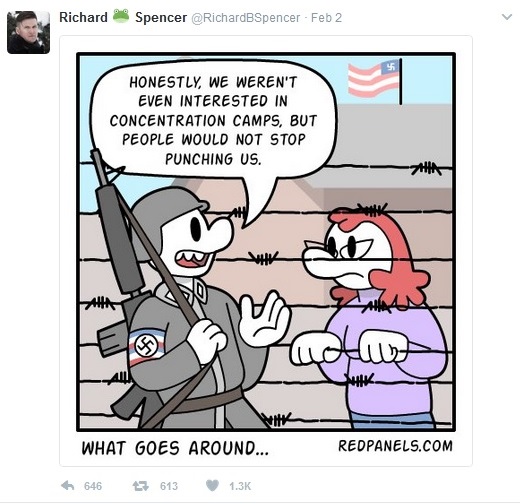
In the very video where Richard Spencer gets punched, right before the fist lands on his face, he is in the middle of denying that he is a neo-Nazi. "Neo-Nazis hate me," he insists. Later on Twitter, however, he tweeted this out. Under the guise of being tongue-in-cheek (as if a white member of an anti-immigration circle calling him- or herself a Nazi is sooo amusing), he is implicitly acknowledging the association of him with neo-Nazism:
If you want to see for yourself the sort of racism that Richard Spencer promotes, you can go to the white nationalist propaganda website he owns and operates, called Radix Journal. It has some mentions of Ayn Rand you might find interesting. One of them is a piece titled "Ayn Rand's Curious Bloodlust," which goes out of its way to denounce the Ayn Rand Institute and, of course, Jews in general. It bemoans, "Faith, racial pride and even loyalty to one’s family if it isn’t based on selfishness were also judged harshly by Rand." Interesting how it threw in "racial pride" between "faith" and "loyalty to one's family" as if it's equally uncontroversial, is it not?
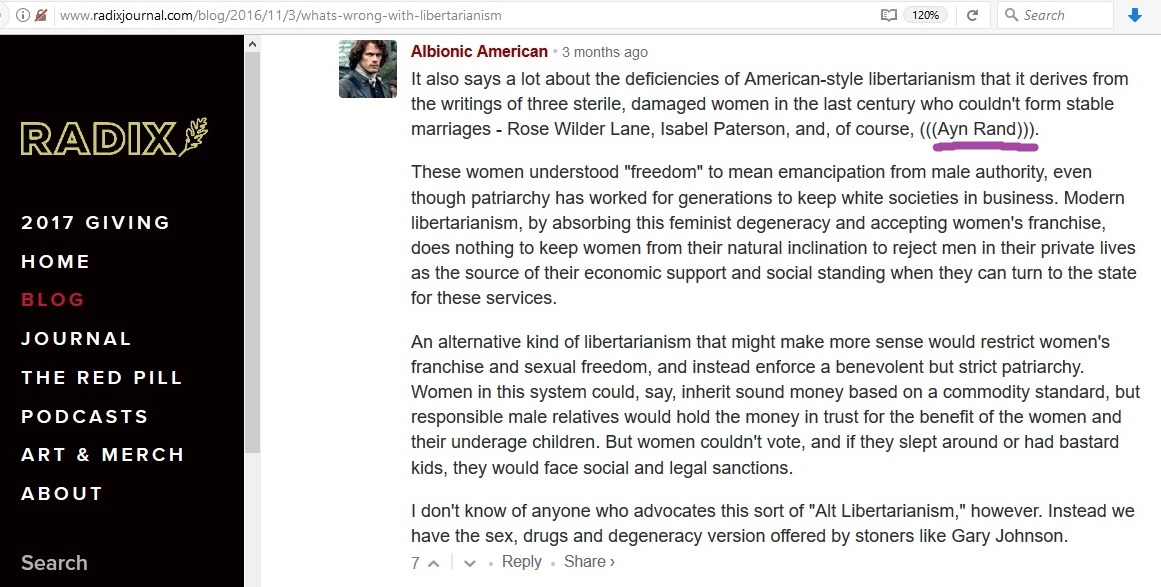
You can also check out "What's Wrong with Libertarianism?" authored by Richard Spencer himself. In that piece, he heaps hostility upon Gary Johnson while, of course, praising Murray N. Rothbard, Hans Hermann Hoppe, and Lew Rockwell. More interesting than that, though, is what you find in the comments section from Spencer's alt-right fan base. "Albionic American" uses the triple-parentheses (((echo)))) for "Ayn Rand" at least twice, and proclaims the need to "restrict women's franchise and sexual freedom, and instead enforce a benevolent but strict patriarchy."
That is Richard Spencer and the ideological company he keeps.
Milo Yiannopoulos: Open Scorn for the Left, Respect for Richard Spencer's Sleaziness
It is concerning that some people who call themselves Objectivists express admiration for Milo Yiannopoulos. From the summer of 2015 to January 2016, I would have told you that I thought Yiannopoulos was not exactly in the alt-right, as being alt-right means going as far as Richard Spencer and Stefan Molyneux: stating explicitly that different "races" have biologically innate behavioral differences and therefore the State must intervene to keep them apart. I would have told you that instead Yiannopoulos is a leading figure in what is called the alt-lite: people who do not state explicit agreement with the eugenics but go out of their way to provide a moral sanction to the alt-right, treating the alt-right as just another opinion and admonishing people to respect it as a legitimate hypothesis worthy of consideration and respect in a pluralistic republic. While members of the alt-lite aren't the ones fervent enough to stick their necks out and say all the racist rhetoric bluntly, they remain fellow travelers who provide encouragement to the more explicit racists and reinforce their antics.
Yet, upon learning on February 18, 2017, that Yiannopoulos actually has a history, going back over ten years, of hinting to people of some sort of sympathy for Naziism, Yiannopoulos might not be just alt-lite; he might really be alt-right and in the same camp as Richard Spencer.
As "proof" of Yiannopoulos opposing the alt-right, some of his fans quote him saying, "White nationalism is not the answer" and his saying that he doesn't agree with how white nationalists are trying to counter the political Left's collectivism with their own. But this gesture is merely perfunctory on his part. You can tell someone's real priorities by his actions. Looking at Yiannopoulos's actions -- as I have done since the autumn of 2014, back when I was following the Gamergate controversy and when Yiannopoulos was then well-known only among those who knew about Gamergate -- allows one to see that while Yiannopoulos heaps nothing but disrespect upon anyone and anything he misconstrues as leftist (such as free-marketers who stand up for the transgendered), he presumes that the alt-right's racism must be paid respect and that its central tenets can only be, at worst, and as-of-yet-unproven hypothesis.
Yiannopoulos came out as the preeminent alt-lite apologist for the alt-right with the essay "An Establishment Conservative's Guide to the Alt-Right," which Yiannopoulos's former friend Cathy Young accurately describes as "a whitewash, full of far-fetched arguments and misleading claims that consistently downplay this movement’s ugly bigotry." "Establishment Conservative's Guide" introduces Richard Spencer and the alt-right as follows:
There are many things that separate the alternative right from old-school racist skinheads (to whom they are often idiotically compared), but one thing stands out above all else: intelligence. . . . The alternative right are a much smarter group of people -- which perhaps suggests why the Left hates them so much. They’re dangerously bright. . . .
The media empire of the modern-day alternative right coalesced around Richard Spencer during his editorship of Taki’s Magazine. In 2012, Spencer founded AlternativeRight.com, which would become a center of alt-right thought.
Alongside other nodes like Steve Sailer’s blog, VDARE and American Renaissance, AlternativeRight.com became a gathering point for an eclectic mix of renegades who objected to the established political consensus in some form or another. All of these websites have been accused of racism.
Note the question-begging presumptions that Yiannopoulos has in those paragraphs: the large group of people who disagree with the alt-right's members -- which he misidentifies as "Left" -- "hates them so much" for no better reason than that the alt-right figures are "smarter." If you compare Richard Spencer and his alt-right cronies to skinheads -- which makes sense, given that white supremacism, and their support for the idea of having a government separate "races" by force, are what the two categories share in common -- then Yiannopoulos is quick to dismiss you as behaving "idiotically." By contrast, Yiannopoulos has no sharper barb for Spencer and his alt-right cronies than "All of these websites have been accused of racism," which is a far cry from Yiannopoulos admitting the obvious: these websites "have been accused of racism" for a solid reason: a reading of these websites demonstrates that these websites blatantly advocate racism.
After a quick and perfunctory admission, "Anything associated as closely with racism and bigotry as the alternative right will inevitably attract real racists and bigots," he goes on to attempt to minimize this. What Yiannopoulos would have us believe are the very few true racists and bigots in the alt-right "are the people that the alt-right’s opponents [merely] wish constituted the entire movement" (emphasis added). He disingenuously assures readers "there's just not very many" real racists in the alt-right, "no-one [in the alt-right, definitely not Richard Spencer] really likes them, and they’re unlikely to achieve anything significant in the alt-right."
Were it the case that it was unlikely for real racists to achieve anything in the alt-right, then it would have been unlikely for Richard Spencer to achieve anything in the alt-right. Yet Yiannopoulos already identified Richard Spencer as the alt-right's thought leader.
He gave a "speech" that simply amounted to the arbitrary sentence "Feminism is cancer." There was no equivalent "The alt-right cancer." He told one left-wing student, "Fuck your feelings." He did not say "fuck" to the feelings of Richard Spencer's ilk (and the racist pseudoscience promoted by Richard Spencer and Stefan Molyneux end up amounting to nothing more than a sprawling rationalization for their own feelings, those feelings being prejudices and unproductive hostility). The implication of Milo Yiannopoulos's public antics has consistently been that he regards Richard Spencer and the alt-right as having the moral high ground over anyone they consider "Left," including moderate Democrats and even Yiannopoulos's former friend, Reason magazine writer Cathy Young.
Yiannopoulos's apologia for Richard Spencer and the alt-right is not some new affectation he adopted to sell books. It goes back at least as far as 2006, when he was in his early twenties. Back then, Milo was calling himself "Milo Andreas Wagner." He wore a Nazi Iron Cross necklace out in public.
In 2009, Yiannopoulos uploaded this image -- supposedly "jokingly," of course.
I learned about those images from this blog post, which chronicles still other instances -- all taking place prior to 2014 -- of Yiannopoulos expressing some sort of anti-Semitism, often rationalizing that being Jewish precludes him from being anti-Jewish.
The main excuse for Yiannopoulos, naturally, is that all of these were mere "jokes" in crude taste. For an explanation as to why that excuse fails to mitigate concerns over the pathology of the crude "joker," read this blog post of mine.
Of course, if we find that Yiannopoulos is at least as favorable to white supremacism as Richard Spencer is, that would still not exonerate the Berkeley riots from moral condemnation. What I said about violence still applies: if Yiannopoulos has yet to initiate the use of actual physical violence, then those who rioted against him demonstrate themselves to be a greater direct physical threat to others than does Yiannopoulos himself.
Now, to the degree that Yiannopoulos is ambiguous about whether or not he realizes that Richard Spencer is a real racist -- and, remember, Yiannopoulos mendaciously asserts that real racists are rare in the alt-right -- that gives Yiannopoulos some weaselly wiggle room whereby he can maintain some plausible deniability about whether he condones Richard Spencer's propaganda specifically. But Stefan Molyneux -- with whom Yiannopoulos exchanged accolades in an online video interview -- is less ambiguous: Molyneux's apologia and whitewashing of Richard Spencer's racism advocacy is much more direct.
Stefan Molyneux's Excuses for Richard Spencer's "White Homeland" to Exclude Nonwhites
Since the autumn of 2015, Stefan Molyneux -- once most famous as the leader of a cult that was purportedly about anarchy -- has become most famous as an online apologist and propagandist for Donald Trump (it does not appear that the cult has disbanded, though). You might have seen my prior critiques of Molyneux's advocacy of eugenics, white supremacism, and government-enforced racial segregation. As an apologist for Trump, Molyneux has also found it necessary to make excuses for some of the unsavory characters who have been manipulating Trump (sometimes even Vladimir Putin). For that reason, Molyneux took it upon himself to make an entire video to rationalize, as purely justified, various disturbing behaviors on the part of Trump's chief strategist, former Breitbart News chairman Steve Bannon. To his credit, conservative commentator Glenn Beck has remained critical of Trump, Bannon, Breitbart News, and the alt-right. Beck pointed out that by catering to the alt-right, Steve Bannon and Breitbart News were elevating and reinforcing the white supremacist agenda of Richard Spencer. On this point, Molyneux decided that defending Steve Bannon against Glenn Beck naturally compelled him to defend Richard Spencer as well. The result is Molyneux delivering mind-bending rationalizations for Richard Spencer's racism.
First, Molyneux approvingly cites Richard Spencer's dishonest comparison of his own agenda to the establishment of Israel. Richard Spencer says that his desire for purely white countries -- which block nonwhites from entry -- is simply to have an "ethno-state" that is to white Christians what Israel is to Jews, and therefore what he promotes is no more objectionable than is present-day Israel. Molyneux announces that he shares in that evaluation completely. As I've explained before, that comparison is misleading. More than a fifth of Israel's population is gentile; this includes Arabs. Over 16 percent of Israel's population is Muslim. According to Israeli law, these non-Jews are to be treated with the same rights and freedom as Jewish citizens. And, yes, as of this writing Israel is accepting orphaned child refugees from Syria.
Secondly, Molyneux resorts to pedantry to distract his audience from the fact that the general thrust of Glenn Beck's criticism of Richard Spencer remains correct. Glenn Beck faults Richard Spencer for advocating that the State intrude upon people's private decisions on whether to have children or not; Beck is concerned about white supremacists calling for the compulsory sterilization of nonwhites. Molyneux replies that Richard Spencer is not calling for compulsory sterilization but is only advocating that tax money be spent to subsidize upper-middle-class whites to have more children, which means that Richard Spencer is benign and that governmental intrusion upon private families' choices is OK. (And this same Stefan Molyneux still calls himself an anarchist.😑 )
Here is the essay of Richard Spencer's that Stefan Molyneux quotes and defends. Richard Spencer says,
We are undergoing a sad process of degeneration. We will need to reverse it using the state and the government. You incentivize people with higher intelligence, you incentivize people who are healthy to have children [Spencer is demanding that the State do this 'incentivization,' and Molyneux approves] . . . .
Today, contraception and birth control are nothing less than a curse [when used by upper-middle-class white couples]! Those with the foresight to engage in 'family planning' [he means upper-middle-class white couples] are exactly the kind of responsible, intelligent people who should be reproducing. And increasingly, middle-class White families are so over-burdened with taxation and the rising costs of housing, healthcare, and education that they don't feel they can afford children [you see? --S.H.]. This is not only a dysgenic catastrophe but a moral one as well.
On the other hand, individuals with low innate intelligence or even criminal personalities [Spencer means blacks and Latinos] -- those who should be limiting their reproduction -- can't be bothered to purchase a condom.
Molyneux approvingly quotes Richard Spencer as saying that because nonwhites are out-competing the white population in terms of out-breeding whites, the solution is for Western governments to manipulate white citizens into having more children as a means of catching up to nonwhites and matching them (as if this is some contest). Molyneux would then have his audience believe that this is not racist; this self-proclaimed anarchist does not even acknowledge how statist an intrusion that is. (This fretting over how white people in rich countries are not having enough children, in competition with nonwhites in poor countries, was started by the first eugenicists in the late 1800s, and this scare was revived in the 1990s. A moderate version of it is called "demographic winter" and the more fanatical version involves the alt-right screaming about "white genocide" in the West. For my deconstruction of this nonsense, read this post.)
Molyneux says of Richard Spencer, "He is making an argument based on facts. And you can agree or disagree." If you don't approve of this, "you would need to find arguments or counter-facts; Richard Spencer would be open to any counterfactual arguments that came his way [lie]." Molyneux's ultimate assessment of Spencer's white nationalism is, "It's not racism if you're pointing out empirical facts about ethnic differences. It's just facts. You hate facts, I guess, if you're on the Left [translation: by 'Left,' Molyneux means everyone who doesn't swallow his rhetoric on race]."
Below, you can watch the excerpt from Molyneux's Steve Bannon apologia that makes excuses for Richard Spencer:
Stefan Molyneux Floats Proposition That "This Battle Has Moved Beyond Words"; Richard Spencer Approves
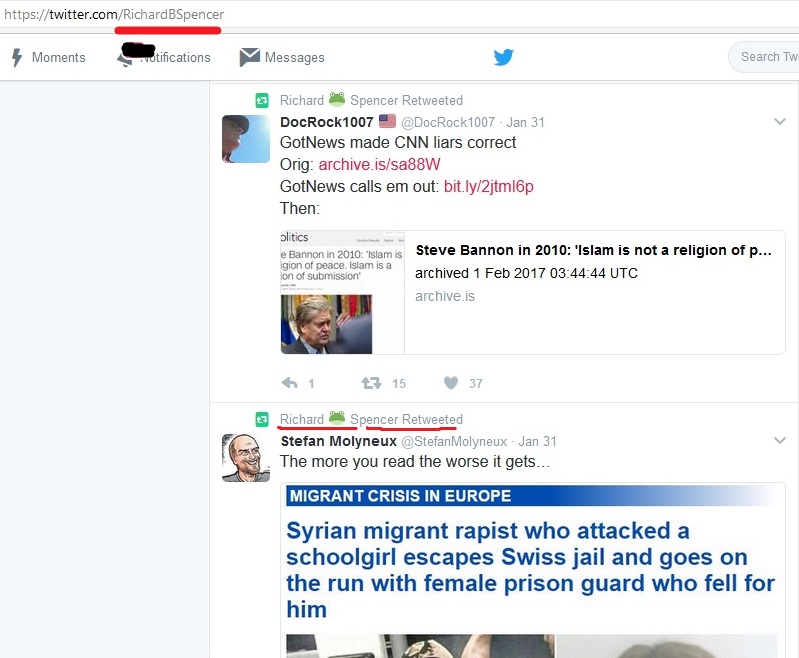
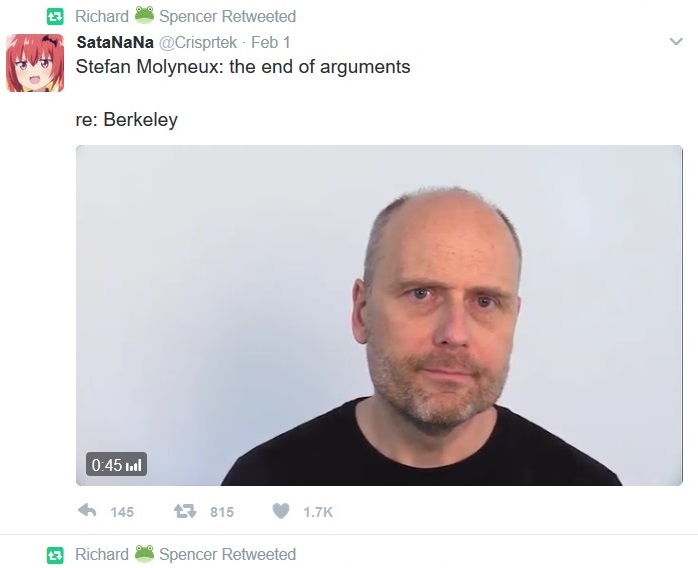
Richard Spencer apparently recognizes an ideological ally when he sees one, as he has taken to retweeting Stefan Molyneux's propaganda.
This is one I find quite noteworthy:
That tweet contains an excerpt from the ending of Stefan Molyneux's video "Anti-Milo Yiannopoulos Rioters Burn UC Berkeley | True News," FDR Podcast 3581. The video purports to be about the riots of misguided people in Berkeley to shut down one of Milo Yiannopoulos's "speeches." Molyneux turns on the crocodile tears and talks as if the Berkeley rioters are representative of everyone in the country who disagrees with the racial fanaticism he preaches. The Americans who disagree with Stefan Molyneux's fanaticism and his calls for State-imposed racial segregation, by means of immigration bans based on IQ and race, number in the hundreds of millions, vastly outnumbering the Berkeley rioters. But Molyneux talks to his audience as if the Berkeley riot is the fundamental essence of the entire rest of the world, the big bad world that rejects his cultish doctrine. For that reason, between crocodile tears, Molyneux almost-whispers,
Maybe the time for arguments is passed. Maybe this battle has moved beyond words. Perhaps my job is over. Perhaps I have failed or the world has failed. Perhaps I am done. For ten years I've been saying '[That's] not an argument' [to anyone who disagrees, even when -- especially when -- they do give real counterarguments]. Tonight, perhaps, it has been made clear there are no more arguments to be made.
It would be great if, by that, Molyneux meant he was finally folding up this dishonest operation, taking all his propaganda off the Web, and finally making a living off of some work that is actually constructive and psychologically healthy. But Molyneux is not giving up. What, then, does he mean that "there are no more arguments to be made"? Since he is not giving up on trying to push his racial separatism, what is meant by "the time for arguments is passed" and "this battle has moved beyond words"? To what is he referring?
Ayn Rand -- the same Ayn Rand whom Stefan Molyneux's pal, Richard Spencer, despises -- gave some insight. The same Leonard Peikoff denounced in Radix Journalexplains in The Ominous Parallels, "There are only two fundamental methods by which men can deal with one another: by reason or by force, by intellectual persuasion or by physical coercion, by directing to an opponent’s brain an argument -- or a bullet." Molyneux is floating the idea to his cult audience that his making persuasive appeals (that is, trying to convince people by reason that his racism is correct 😑) is no longer a viable option, and, therefore, if his cult audience is to have its way, it must have some other recourse. But what other recourse is left? Ayn Rand -- the one Richard Spencer reviles -- notes in "The Comprachicos," "When men abandon reason, physical force becomes their only means of dealing with one another and of settling disagreements."
Molyneux is floating the proposition to his cult audience that maybe he should stop with trying to reason other people into, well, his thoroughly irrational racial segregationism. If Molyneux and his audience come to conclude that that is the case, then pushing their own agenda, their own cause, would require that they go through with that one other recourse. Richard Spencer retweeted that monologue because that is the exact direction that he would push the Molyneux cult toward. And should the day come when Richard Spencer and the Molyneux cult decide that "this battle has moved beyond words" and that they will fight with their fists, then, yes, you will be justified in punching them back.
Conclusion
Yes, Richard Spencer is a neo-Nazi. Yes, Milo Yiannopoulos has done his part to normalize Richard Spencer's bigotry and to demonstrate his own pathological obsession with Nazi iconography. And Stefan Molyneux has made an unambiguous apologia for that bigotry; one cannot pretend that Molyneux is "only joking" about this.
Executive Summary Here is a 46-minute video montage demonstrating that Stefan Molyneux parrots and cites the anti-Semite conspiracy theories of Kevin MacDonald, praised as an ally by David Duke himself. The first 8 1/2 minutes allow Kevin MacDonald to explain his deranged conspiracy theories about Jews. From the 8:34 mark onward, the video flips back and forth between MacDonald and Molyneux. First it lets MacDonald explain more of his conspiracy theories. Then it switches to Molyneux repeating those same talking points about Jews, in general, engaging in shadowy plots against "white Christians." At the 18 minute, 12 second mark, Molyneux cites MacDonald by name.
Molyneux: Spreading Bigotry Against Jews, Too
I have previously written about Stefan Molyneux's citation of the Pioneer Fund's antiquated eugenicist pseudoscience to provide a scientific veneer for his bigoted pronouncements about blacks, Latinos, and Arabs. While listening to some of his podcasts I got a whiff of anti-Semitism about Molyneux as well, but the anti-Semitism was not as overt as the out-and-out hostility toward the aforementioned ethnic categories. Yet looking further into this I have discovered that my suspicions about the anti-Semitism are confirmed . . . and more virulent than I had anticipated. Molyneux parrots conspiracy theories about Jews most infamously propagated by retired Californian psychology professor Kevin MacDonald, a proven anti-Semite and close associate of David Duke, former Grand Wizard of the Ku Klux Klan. As MacDonald wrote on his own website on July 1, 2016,
I have been appearing on the David Duke radio show as a regular guest, every two weeks or so, for quite a while. This was a difficult decision at first, but I am very comfortable with it. . . . After watching David Duke’s videos and reading his writings, I decided that I agree with the vast majority of what he is saying.
And Molyneux cites MacDonald by name in disseminating this paranoid propaganda, as if MacDonald is a scrupulous academician and reliable source of information.
David Duke starts a Skype interview with MacDonald by introducing him as "my good friend and an incredible academic" -- no ironic pun intended with incredible. Unsurprisingly, MacDonald himself cites dubious sources, as in the case of MacDonald citing, as a credible source, J. Philippe Rushton, the known eugenicist and white supremacist who in his lifetime led the Pioneer Fund (one of the few remaining eugenics thinks-tanks in the USA). As you can see here, as of this writing David Duke has interviewed MacDonald over twenty times. Why does David Duke cherish MacDonald so much? It is because of MacDonald writing pseudo-scholarly works to provide the illusion of academic credibility for his conspiracy theories about Jews. The main video where Molyneux cites and repeats MacDonald, "The Truth About Immigration: What They Won't Tell You!," had been uploaded onto YouTube seven months prior to MacDonald becoming a regular guest on David Duke's podcast. Still, by that time -- July 2014 -- MacDonald had already been well-known for his propaganda against Jews.
First I will describe MacDonald's conspiracy theories. Once done with that, I will go over how Molyneux largely repeats them -- again, citing MacDonald by name -- and modifies them only slightly.
1.MacDonald insists both (a) communism and (b) the activist campaign for liberalizing immigration laws are conspiracies concocted by Jews. As of this writing, I haven't yet heard MacDonald say that the push for more open immigration is necessarily a communist conspiracy. Rather, MacDonald seems to be saying that initially Jews invented communism as a conspiracy but then, decades into it, lost interest in communism, despite remaining mostly on the political Left (he also derides the allegedly right-wing neo-conservatism of the Kristol family as a Jewish conspiracy). After having squeezed all they could get out of communism, MacDonald continues, Jews then cooked up a new conspiracy: lobbying for more open immigration into the United States and Western Europe.
2. MacDonald says that Jews advocating any ideological position is indeed a conspiracy because Jewish intellectuals who profess to believe sincerely in any political viewpoint are lying; they are masking their actual exploitative endgames. MacDonald says that a disproportionately large percentage of the early advocates of communism were Jewish, that a large portion of the advocates of open immigration are Jewish, and that the postwar advocates of neoconservatism are mostly Jewish. That evaluation is not very controversial. The Jerusalem Postquotes Yaron Brook making a similar observation about how various competing philosophic movements often have Jewish leaders. Indeed, Ayn Rand came from a Jewish family and so did many early students of the Objectivist philosophy. I won't be surprised if MacDonald says Objectivism is another Jewish conspiracy.
What is inflammatory is MacDonald's accusation concerning intent. MacDonald says that when a large number of Jewish intellectuals argue for any ideological viewpoint -- be it socialism, neo-conservatism, or libertarianism -- those Jewish intellectuals are, perforce, not sincere in agreeing with what they are saying. Rather, MacDonald continues, this is a ruse -- ruse is the exact word he employs -- to mask what Jews really want. Regardless of whether Jewish intellectuals are arguing for capitalism or socialism, says MacDonald, Jews are only trying to gain political and/or economic power for Jews at the expense of the gentiles around them, especially Christians of Western European descent. That is, if a Jewish intellectual argues for free trade, he does not genuinely believe that free trade will benefit gentiles; this is just a ploy whereby Jews can manipulate and exploit those gentiles. Likewise, MacDonald continues, if Jewish intellectuals argue that the U.S. federal government should liberalize immigration from Mexico, then the Jewish intellectuals are merely trying to manipulate Mexicans for their own ends, mostly to the material detriment of non-Hispanic gentiles.
3. MacDonald says Jews, communism, and the liberalization of immigration laws are all linked, since both communism and open immigration are Jewish conspiracies. Again, I don't know of MacDonald saying that open immigration is a communist conspiracy. He sounds like he is saying that communism was an earlier Jewish conspiracy and then, as Jews were losing interest in communism, they eased into the newer conspiracy that is immigration liberalization. As MacDonald puts it on the white nationalist website VDare (cited on Stormfront),
In my research on Jewish involvement in shaping immigration policy, I found that the organized Jewish community has been the most important force favoring unrestricted immigration to the U.S. In doing so, the various entities involved have consistently acted to further their own perceived collective interests—interests that are arguably in conflict with those of the majority of Americans.
4. MacDonald condemns the 1965 Hart-Celler Act as a left-wing elite Jewish globalist conspiracy. MacDonald talks first about the Johnson-Reed Act of 1924 and then the 1965 Hart-Celler Act. The Johnson-Reed Act established national quotas for immigration on bases that were explicitly eugenicist and explicitly racist. By MacDonald's own admission, the argument for the bill was that southern Europeans and Eastern Europeans were genetically, racially, and culturally inferior to the native-born majority of Americans at the time, who mostly descended from people of western and northern Europe. Of course, many of those Eastern Europeans blocked from immigrating were Jews. MacDonald says that there wasn't much good reason for native-born Americans to fear gentiles from Eastern Europe, but that they were indeed right to want to keep Eastern European Jews out of the USA.
The national origin quotas favored immigrants from Western Europe over those from Eastern Europe, allowing for a larger number of people from Great Britain to enter the USA than, say, those from Poland. However, MacDonald bemoans, this system was undermined by efforts of left-wing elitist Jewish (globalist) activists (elite is exactly the word he uses) who lobbied for a more liberalized system of immigration. According to MacDonald, left-wing (globalist) Jews wanted more "Third World immigration" (that is, immigrants from Africa, Asia, and Latin America) coming into the USA because it would do more to make Western-European-descended Christians a minority. Moreover, continues MacDonald, left-wing (globalist) Jews could form a political "coalition" with activists from these other ethnic groups and then it would be more difficult for Western-European-descended Christians to gang up on them.
Then MacDonald wails that the (globalist) Jewish activists succeeded with the passage of the 1965 Hart-Celler Act, which Ted Kennedy championed. MacDonald says that Ted Kennedy assured (racist) doubters that the bill was OK because it would not change the demographics of the country (that is, WASPs would maintain a majority). Then MacDonald points out that over the past half-century the demographics have indeed changed. MacDonald therefore insists that Ted Kennedy very consciously chose to lie, as it was his conscious intention to alter the racial makeup of the country, and that it was the globalist Jewish lobby that very decidedly put him up to it.
We are to believe from MacDonald that by removing the explicitly racist national origin quotas, the Hart-Celler Act made it easy for dark-skinned people from poor countries to enter the USA, opening the floodgates for a barbarian horde. In reality, MacDonald's characterization of the Hart-Celler Act as near-anarchic deregulation is misleading. The Hart-Celler Act created the present system, which says that to immigrate to the USA for the long term, you may do so to seek higher education (student visas), work (H-1B visas), or reunite with family members (family reunification visas). While the explicit national origin quotas are gone, there remain caps on the number of visas that can be issued per country. Since Mexico adjoins the continental USA, it is not surprising that 30 percent of visa applications come from Mexico. Yet no more than 7 percent of all visas issued annually can go to Mexican nationals.
If you are a Mexican who is a spouse or minor child of a permanent U.S. resident, you will have to wait an average 6 years to obtain a family reunification visa -- and that's one of the categories with one of the shorter waiting periods. If, as a Mexican, you are the sibling of a U.S. citizen, the estimated waiting time for a visa is 16 years (see the first page of this PDF). Moreover, H-1B work visas are accessible almost exclusively to persons who hold university degrees (as Melania Trump's case reminds us, a rare exception is made for fashion models). Since impoverished people in impoverished countries still mostly have to farm for their food, they rarely ever scrimp together the resources needed to obtain university educations. For that reason, contrary to MacDonald's disingenuous claims, the present system created by the Hart-Celler Act still stacks the deck against (dark-skinned) penurious people from the "Third World." The 1965 law did not unleash any type of mass migration.
In any case, MacDonald's points here are (a) the national origins regime from 1924 to 1965 was wonderful, (b) everything went to hell from 1965 onward when the Hart-Celler Act allowed for a barbarian horde of non-white people to flood into the USA, (c) this is the result of a left-wing elite Jewish globalist plot, and (d) this happened because Ted Kennedy let himself be a pawn of this left-wing elite Jewish globalist plot.
5. MacDonald condemns Jews (not particular individuals who happen to be Jewish, but Jews in general) as hypocrites.This is a favorite talking point of Stefan Molyneux and other anti-Semites, such as Ann Coulter (see here and here), and these anti-Semites apparently adopted it from MacDonald. The talking point is as follows: most Jews in Western Europe and the English-speaking countries argue for more liberalized immigration into the countries of their present residence (MacDonald doesn't want to admit that the United States is the home country of a Jewish-American). MacDonald (and then Molyneux after him) particularly takes offense at Jewish intellectuals who stand up for the rights of Mexicans to enter the USA peaceably and who have expressed revulsion at Donald Trump's proposal to build an enormous wall to keep them out. MacDonald says that Jews who argue for liberalizing immigration are hypocrites, because the state of Israel itself has border walls to keep out enemy troops from Hamas, and Israel itself has restrictive immigration laws.
That is whacking at a tremendous straw man. First, Israel remains officially at war against Hamas, Syria, and other adjoining states. A legitimate purpose of national borders is to repel military threats. By contrast, the United States is not in a state of war against Mexico, and undocumented Mexicans who enter the USA for work are not military threats. Even if a Mexican acted in consistency with the bigoted stereotypes -- even if that Mexican came to the USA fully intending to benefit from welfare and to put his children into taxpayer-funded government schools, that still would not be an act of war against the United States. The comparison between Israel's border walls against Hamas and Trump's proposed border wall against Mexico therefore fails.
Secondly, the Israel-policy-makes-Jews-all-hypocrites assertion fails to make a distinction between Jews and the Israeli government. It's sad that something so obvious has to be explicated: a Jew doesn't have to agree with every policy of the Israeli government. Yaron Brook of the Ayn Rand Institute, originally from Israel, for instance, has mentioned that he is not happy about Israel's border walls.
I am not Jewish but, for what it's worth, should there come a day when military hostilities cease -- and that would be very good -- there won't be any worthwhile reason for Israel to maintain the border walls.
Anyhow, Stefan Molyneux "adapts" these same talking points from MacDonald, citing him by name, and the differences between Molyneux's version and MacDonald's are merely superficial.
1.-2.Molyneux agrees that communism is a conspiracy concocted by Jews. Says Molyneux,
Communism doesn't particularly come from the Greek, Roman, Western, Enlightenment tradition [true --S.H.]; it generally comes from Jewish tradition [highly misleading claim; communism, as with other forms of collectivism, is a systematized codification of collectivist traditions that go back to the days of hunter-gatherer clans, predating all these other cultures --S.H.]. Certainly, of course, the founders of communism were Jews [misleading; Karl Marx came from a Jewish family but denounced Jews as selfish capitalists --S.H.]. Jews were less than 2 percent of the Russian population but were more than 50 percent of the leaders of the Communist Party, and, of course, a lot of them were in charge of concentration camps and so on, later on under the Soviet regime [note Molyneux's conspicuous insistence on using the term "concentration camps" and saying that Jews ran them --S.H.].
Whereas an important part of MacDonald's conspiracy theories is that he says that Jews are seldom sincere in expressing any political convictions, I have yet to hear Molyneux say that explicitly. Nonetheless, MacDonald's other accusations -- particularly about Jews obsessing over domination of gentiles -- remain crucial to Molyneux's accusations in the "Truth About Immigration" video. When you look at Molyneux's typed-up source notes, the reference for Molyneux's announcement that Jews ran concentration camps in the Soviet Union is none other than an essay by Kevin MacDonald called "Stalin's Willing Executioners: Jews As a Hostile Elite in the USSR," which is a review of a book by Yuri Slezkine titled The Jewish Century.
3.Molyneux, like MacDonald, says that Jews, communism, and immigration liberalization are all connected, though he does not phrase this exactly in the same way that MacDonald does. Molyneux is more roundabout in trying to put these together. We remember that Molyneux said that communism is predominantly Jewish. Then he says that immigration restriction from 1924 to 1965 was indeed wise and well-justified because Eastern Europeans were communist agents, and when such communist agents entered the USA, they would commit terrorism, espionage,and other acts of violence. Hence, says Molyneux, it was good for the U.S. federal government to ban from the United States any immigrant who might potentially be a communist agent. Since Molyneux said previously in the same video that communist agents were predominantly Jewish, the deductive conclusion the audience is to draw from this is that Molyneux believes that the U.S. federal government was right to block Jewish immigrants in particular.
This, he insists, "was a justified fear, given how rapidly communism had spread throughout the world." Unfortunately, he adds, there was "Jewish opposition" to legislation that very reasonably tried to ban Eastern European Jews who might turn out to be communist agents. But, Molynuex goes on, U.S. Congressman John Rankin laudably pushed back against these Jews.
In attempt to maintain some plausible deniability about whether he agrees fully with this opinion, Molyneux conspicuously employs the "passive voice" in proclaiming:
So there is this concern -- and the degree to which this is valid is certainly arguable -- there is this concern in the minds of a lot of Christian Americans, and this was of course the case in Germany[!!] as well, there was this concern that communism equals Judaism and when communists, a.k.a. Jews, get in power, then a lot of Christians are not long[-lived] for this world, so this is sort of what he [John Rankin] is talking about, and this is all vanished from history [bowdlerized and scrubbed by a politically-correct globalist cabal] and not because it's entirely false. Again, the degree of [Jewish] influence is arguable; we'll talk about more facts [sic] here, but I guess Christians aren't quite as good at telling stories [as allegedly conspiring Jews are].
In this particular video, Molyneux does not repeat MacDonald precisely in proclaiming that Jews lobbied for the Hart-Celler Act primarily to undermine white gentile culture. However, like MacDonald, Molyneux does say that Jews favoring the Hart-Celler Act wanted to get more Jews in particular into the USA. Moreover, Molyneux does repeatedly state that a left-wing globalist conspiracy is pushing for liberalization of immigration in order to undermine white Christian culture in the West (not using the word Jew in that isolated context). And since Molyneux also says that left-wing people who argue for liberalizing immigration are predominantly Jewish, one is to deduce that Molyneux is intimating that this supposed left-wing elite globalist conspiracy to maintain power through "importing"dark-skinned immigrants from "the Third World" is indeed a conspiracy orchestrated by Jews. After conveying that he considers multiculturalism to be synonymous with immigration liberalization, Molyneux says, "Jews, through communism, promote multiculturalism -- and, of course, multiculturalism is promoted by non-Jews, of course [sic; the repetition of of course is Molyneux's] as well -- and this causes problems within the host countries," that is, countries receiving dark-skinned immigrants.
4.Starting here, Molyneux repeats all of MacDonald's favorite talking points about the 1924 Johnson-Reed Act's eugenicist quotas, the 1965 Hart-Celler Act supposedly opening up the USA to "Third World immigration," and of Ted Kennedy lying about demographic change on behalf of a globalist (Jewish) cabal.
5. Here Molyneux repeats the talking point about how any Jew who stands up for Mexican immigrants and against Donald Trump's proposed border wall is a hypocrite on account of Israeli policies.
Final Notes
Molyneux's denunciations of Jews go back more than a decade. On April 9, 2005, he said that
mental health has always been defined in social terms – a combination of sustained relationships and productive work. In other words, a popular Auschwitz guard with a long marriage is the very definition of mental health. Moral considerations do not form the basis of mental heath – a compliant Nazi is considered more ‘healthy’ than an outcast one. This form of ‘social ethics’ is largely due to the Jewish influence over psychology. It would be hard for a Jew to say that individual morality is more important than social acceptance, since to be ‘Jewish’ is to automatically place the authority of the group over the conscience of the individual – just as Christians, socialists, Muslims and soldiers do.
MacDonald says "major anti-Jewish movements throughout history have been the result of real conflicts of interest. . . . I wrote a book called The Separation and Its Discontents. It deals with various anti-Semitic movements, anti-Jewish movements. All of them were deeply involved with Jewish domination [over non-Jews] of one kind or another."
Molyneux agrees that Israel is all about Jewish domination over Palestinians and Arabs of neighboring states:
What is often described as a civil war between Jews and Arabs in Mandatory Palestine was, in fact, little more than an ethnic cleansing campaign carried out by Zionists. ...if the horrors committed by the Nazis continue to live on in the minds of the Jews, how can we expect the Palestinians to forget what was done to them? I'm not equating the Jews with the Nazis [obvious lie] but, from the standpoint of the victims, there are obvious similarities.
It is not a mere suspicion that Molyneux is interested in disseminating anti-Semite propaganda. He repeats conspiracy theories about Jews, conspiracy theories transmitted by David Duke acolyte Kevin MacDonald, and Molyneux cites this same Kevin MacDonald repeatedly.
Again, here is the 46-minute montage where you can hear Stefan Molyneux and his anti-Semite conspiracy-theorist source speak for themselves.
UPDATE from Tuesday, November 22, 2016: Stefan Molyneux repeatedly makes the disingenuous claim that Richard Spencer's explicitly eugenicist white nationalism is no worse than Zionism. He says Israel is an "ethno-state" for excluding gentiles. What renders the claim so mendacious is that Israeli statutes are not about exiling gentiles, such as Arab Muslims, and Israel is more diverse than Stefan Molyneux and Richard Spencer would have people believe. See the follow-up posting refuting Molyneux over here.